Les balbutiements de l’Internet
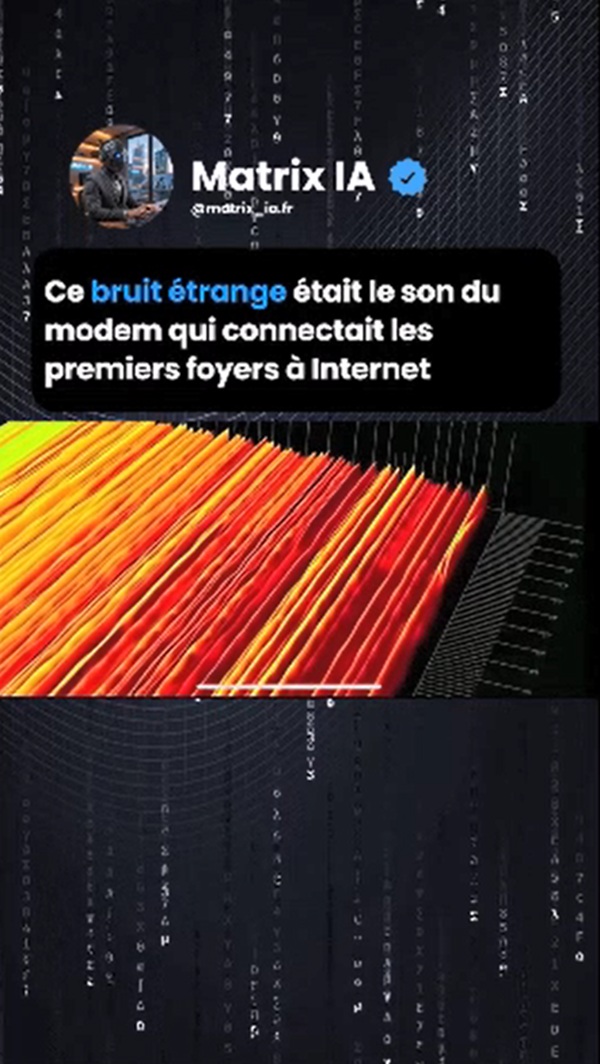
Ce son a été le seuil d’entrée sur Internet pendant une quinzaine d’années. La vidéo transforme la négociation du modem en spectrogramme 3D, ce qui rend visible une conversation que tout le monde entendait sans jamais la comprendre.
La connexion passait par une ligne téléphonique ordinaire, donc les deux modems n’avaient qu’un seul moyen de se parler : le son. Ils se présentaient, annonçaient les protocoles qu’ils savaient parler, testaient le signal, mesuraient les interférences, puis se mettaient d’accord sur la vitesse maximale que la ligne pouvait tenir ce jour là.
Sur l’image, chaque pic correspond à une fréquence et les couleurs traduisent l’intensité du son. Le rouge marque les signaux faibles, le violet et le bleu les moments les plus chargés de l’échange.
Toute cette négociation durait quelques secondes à peine, mais c’est elle qui décidait si la connexion s’établissait ou si l’écran affichait un message d’erreur. Une fois l’accord trouvé, le haut-parleur se coupait et la ligne passait en transmission de données, à 33,6 puis 56 kilobits par seconde selon les générations.
Si le haut-parleur restait ouvert pendant ces quelques secondes, ce n’était pas un défaut de conception. C’était le seul moyen d’entendre une ligne occupée, un mauvais numéro ou une négociation qui échouait, sans avoir à décoder quoi que ce soit.

The early days of the Internet
This sound was the entry point to the Internet for about fifteen years. The video transforms the modem’s negotiation into a 3D spectrogram, making visible a conversation that everyone heard but never understood.
The connection was via an ordinary telephone line, so the two modems only had one way of communicating: sound. They introduced themselves, announced the protocols they knew how to use, tested the signal, measured interference, and then agreed on the maximum speed the line could handle that day.
In the image, each peak corresponds to a frequency, and the colors represent the intensity of the sound. Red indicates weak signals, while purple and blue mark the most intense moments of the exchange.
This entire negotiation lasted only a few seconds, but it was this process that determined whether the connection was established or if the screen displayed an error message. Once an agreement was reached, the speaker switched off and the line switched to data transmission, at 33.6 and then 56 kilobits per second depending on the generation.
If the speakerphone remained open for those few seconds, it wasn’t a design flaw. It was the only way to hear a busy signal, a wrong number, or a failed negotiation without having to decode anything.

Stéphane Guibert (Facebook) / Sur (VK) / CrowdBunker/ X
