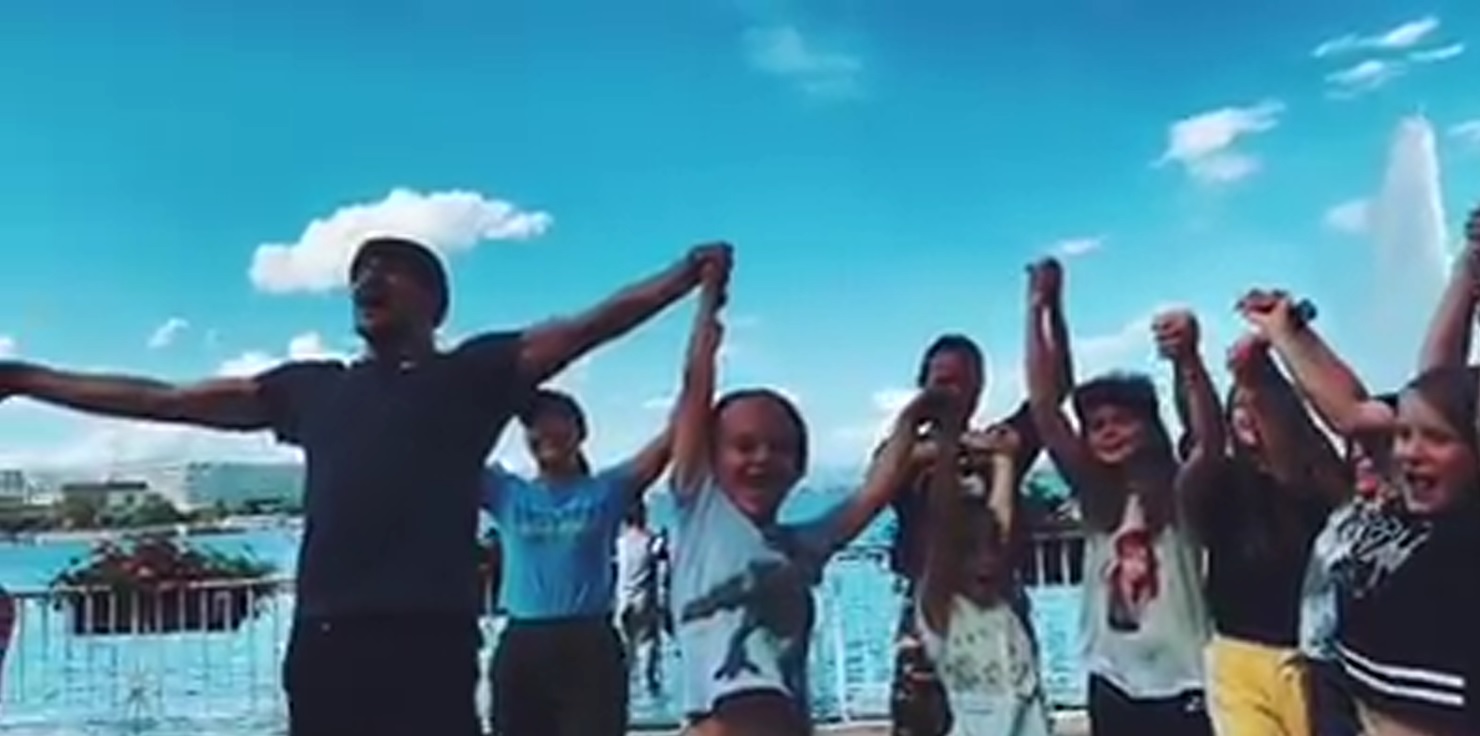
En amour comme en amitié, profite de l’instant qui s’offre à toi sans te poser de question
La vie est courte, elle peut te prendre en traitre et tout te reprendre du jour au lendemain sans prévenir
Un tiens vaut mieux que deux tu l’auras, un je t’aime vaut mieux que deux je t’aimerai pourtant, malgré l’évidence d’une amitié ou d’un amour, certains ne semblent pas les apprécier à leur juste valeur.
La vidéo illustrant ce court article a été réalisée par votre serviteur avec l’aimable permission du groope Universal Music.
*****
În dragoste ca în prietenie, profită de momentul care ți se oferă fără să-ți pun o întrebare
Viața este scurtă, ea poate, ca un trădător, să reia totul peste noapte fără avertisment
Una dintre a ta este mai bună decât două pe care le vei avea, una te iubesc este mai bună decât două te voi iubi, în ciuda dovezilor unei prietenii sau a unei iubiri, unii nu par să le aprecieze la adevărata lor valoare.
Videoclipul acestui scurt articol a fost produs de mine, prin amabilitatea Groope Universal Music.
*****
In love as in friendship, take advantage of the moment that is offered to you without asking you any question
Life is short, she can, like a traitor, resume everything overnight without warning
One that I give you is better than two that I will give you, one I love you is better than two I will love you however, despite the obviousness of a friendship or a love, some do not seem to appreciate them for their fair value.
The video illustrating this short article was produced by yours truly with the kind permission of the Universal Music Group.
Le président français, Emmanuel Macron, a déclaré :
«Avec une famille qui a sept, huit enfants en Afrique, investissez des milliards, rien ne changera. (…) Le défi de l’Afrique est civilisationnel.» Le sociologue guinéen Amadou Douno, professeur à l’Université Ahmadou-Dieng de Conakry, lui répond.
«Les Africains n’ont pas besoin de votre civilisation de débauche. Parce qu’avec votre civilisation : un homme peut coucher avec un homme ; une femme peut coucher avec une femme ; un président célibataire peut avoir deux maîtresses à la fois ; une femme peut coucher avec son chien ; un enfant peut insulter son père et sa mère sans problème ; un enfant peut faire emprisonner ses parents.»
«Avec votre civilisation, quand les parents prennent de l’âge, on les emmène à la maison de retraite, et, enfin, avec votre civilisation, un jeune homme peut vivre avec une femme qui a l’âge de sa mère ou sa grand-mère sans problème. Votre cas en est une parfaite illustration !
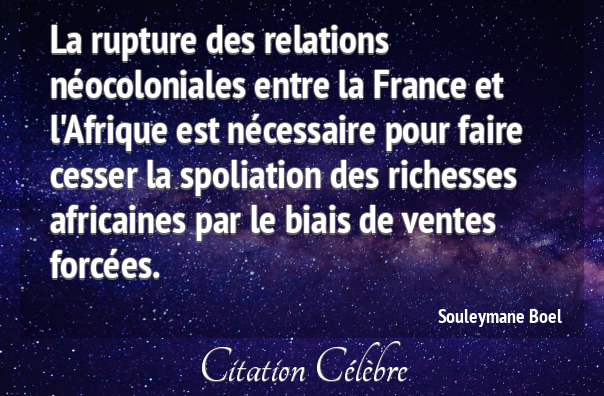
«Le défi de l’Afrique, c’est de se débarrasser de la France. Parce que cette dernière n’est pas la solution à son sous-développement, elle est au cœur du problème !».
Amadou Douno, professeur à l’Université Ahmadou-Dieng de Conakry
*****
PROVOCAREA AFRICANĂ
SOCIOLOGUL GUINEIAN RĂSPUNSE LA MACRON
Președintele francez Emmanuel Macron a spus :
„Cu o familie care are șapte, opt copii în Africa, investește miliarde, nimic nu se va schimba. (…) Provocarea Africii este civilizațională. » Îi răspunde sociologul guinean Amadou Douno, profesor la Universitatea Ahmadou-Dieng din Conakry.
„Africanii nu au nevoie de civilizația ta desfrânată. Pentru că odată cu civilizația ta: un om se poate culca cu un bărbat; o femeie se poate culca cu o femeie; un singur președinte poate avea două amante în același timp; o femeie se poate culca cu câinele ei; un copil își poate insulta tatăl și mama fără probleme; un copil își poate avea părinții închiși. ”
„Cu civilizația ta, când părinții îți îmbătrânesc, ești dus la o casă de pensionare și, în cele din urmă, cu civilizația ta, un tânăr poate trăi fără probleme cu o femeie de vârsta mamei sau a bunicii sale. Cazul tău este o ilustrare perfectă !
„Provocarea Africii este să scape de Franța. Deoarece aceasta din urmă nu este soluția subdezvoltării sale, ea se află în centrul problemei! «
Amadou Douno, profesor la Universitatea Ahmadou-Dieng din Conakry
*****
THE AFRICAN CHALLENGE
GUINIAN SOCIOLOGIST ANSWERS MACRON
French President Emmanuel Macron said :
“With a family that has seven, eight children in Africa, invest billions, nothing will change. (…) Africa’s challenge is civilizational. » Guinean sociologist Amadou Douno, professor at Ahmadou-Dieng University in Conakry, answers him.
“Africans don’t need your debauchery civilization. Because with your civilization: a man can sleep with a man; a woman can sleep with a woman; a single president can have two mistresses at the same time; a woman can sleep with her dog; a child can insult his father and mother without problem; a child can have his parents imprisoned. «
“With your civilization, when the parents get older, they are taken to the retirement home, and, finally, with your civilization, a young man can live with a woman who is the age of his mother or her grand-mother without problem. Your case is a perfect illustration of this!
“The challenge for Africa is to get rid of France. Because the latter is not the solution to its underdevelopment, it is at the heart of the problem! «
Amadou Douno, professor at Ahmadou-Dieng University in Conakry
Laissons à nos enfants un monde libre qui ne renonce à aucune de ses valeurs fondamentales !
Chérissons la Liberté comme nous chérissons nos enfants, d’elle, dépend l’avenir de ceux-ci .
Sans commentaire !
*****
Videoclipul zilei : « Libertate ! »
Bravo, omule!
Să lăsăm copiilor noștri o lume liberă care nu renunță la niciuna dintre valorile sale fundamentale!
Să prețuim libertatea așa cum ne prețuim copiii, de viitorul lor depinde.
Fără comentarii !
*****
The video of the day : « Freedom ! »
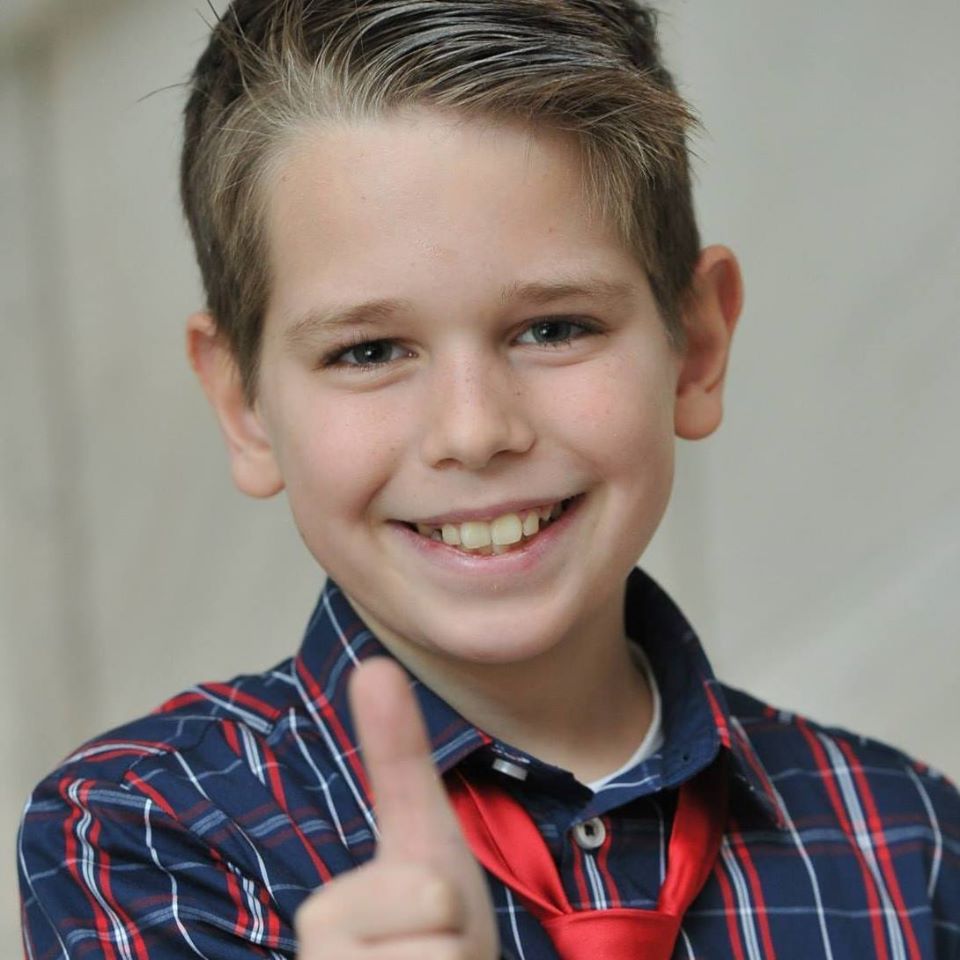
Well done, Kid !
Let us leave to our children a free world which does not give up any of its fundamental values! Let us cherish Freedom as we cherish our children, on their future depends.
« La légende raconte qu’un jour la vérité et le Mensonge se sont croisés. »
– Bonjour, a dit le Mensonge.
– Bonjour, a dit la Vérité.
– Belle journée, a continué le Mensonge.
Alors la Vérité est allée voir si c’était vrai. Ça l’était.
– Belle journée, a alors répondu la vérité.
– Le lac est encore plus beau, a dit le mensonge avec un joli sourire.
Alors la Vérité a regardé vers le lac et a vu que le mensonge disait la vérité et a hoché la tête.
Le Mensonge a couru vers l’eau et a lancé …
– L’eau est encore plus belle et tiède. Allons nager !
La vérité a touché l’eau avec ses doigts et elle était vraiment belle et tiède. Alors la Vérité a fait confiance au mensonge. Les deux ont enlevé leurs vêtements et ont nagé tranquillement.
Un peu plus tard, le mensonge est sorti, il s’est habillé avec les vêtements de la vérité et il est parti.
La vérité, incapable de porter les habits du mensonge a commencé à marcher sans vêtements et tout le monde s’est éloigné en la voyant nue. Attristée, abandonnée, la Vérité se réfugia au fond d’un puits. C’est ainsi que depuis lors les gens préfèrent accepter le Mensonge déguisé en vérité que la Vérité nue. »
„Legenda spune că într-o zi adevărul și minciuna s-au încrucișat”.– Bună, a spus Adevărul.
– Bună, a spus Adevărul.
– O zi frumoasă, spuse mincinosul
Deci Adevărul a mers să vadă dacă este adevărat. Era.
– Zi frumoasă, apoi a răspuns adevărul.
– Lacul este și mai frumos, a spus minciuna cu un zâmbet frumos.
Așadar, Adevărul s-a uitat la lac și a văzut minciuna spunând adevărul și a dat din cap.
Minciuna a fugit în apă și a spus …
– Apa este și mai frumoasă și mai caldă. Să mergem să înotăm !
Adevărul a atins apa cu degetele și a fost atât de încântătoare și călduță. Deci Adevărul a avut încredere în minciună. Cei doi și-au scos hainele și au înotat în liniște.
Puțin mai târziu a ieșit minciuna, s-a îmbrăcat în hainele adevărului și a plecat.
Adevărul, incapabil să poarte hainele minciunii, a început să meargă fără haine și toată lumea a plecat văzând-o goală. Întristat, abandonat, Adevărul s-a refugiat în fundul unei fântâni. Astfel, de atunci oamenii au preferat să accepte Minciuna deghizată ca adevăr decât Adevărul gol. «
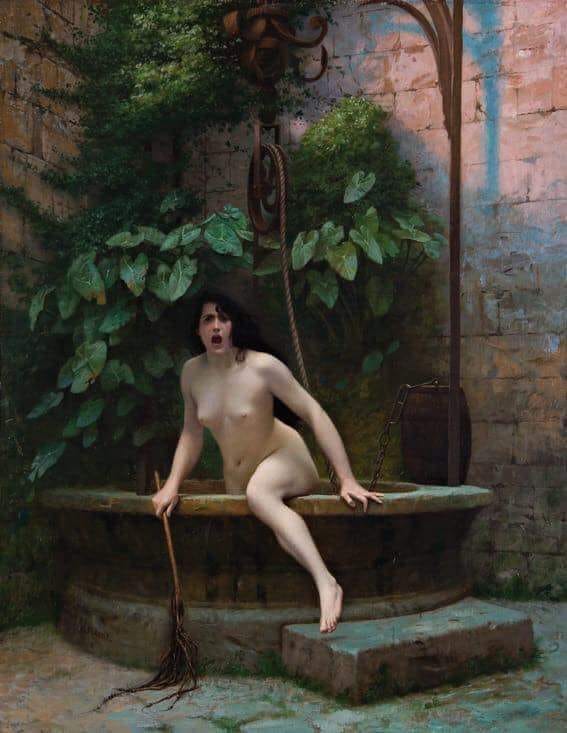
Adevărul venind din fântână – Jean-Léon Gérôme 1896
*****
Image of the day : lie and truth
« Legend has it that one day Truth and Lie crossed paths. »
– Hello, said the Lie.
– Hello, said the Truth. – Beautiful day, continued the Lie.
So the Truth went to see if it was true. It was.
– Beautiful day, then answered the truth.
– The lake is even more beautiful, said the lie with a pretty smile.
So the Truth looked to the lake and saw the lie was telling the truth and nodded. The Lie ran into the water and said …
– The water is even more beautiful and warm. Let’s go swimming !
The truth touched the water with her fingers and it was so lovely and lukewarm. So the Truth trusted the lie. The two took off their clothes and swam quietly.
A little later the lie came out, he dressed in the clothes of truth and left.
The truth, unable to wear the clothes of lying began to walk without clothes and everyone walked away seeing her naked. Saddened, abandoned, Truth took refuge at the bottom of a well. Thus since then people have preferred to accept the Lie disguised as truth than the naked Truth. »
The truth coming out of the well – Jean-Léon Gérôme 1896
Le Concours Eurovision de la chanson junior 2018 était la seizième édition du Concours Eurovision de la chanson junior, organisé par la Compagnie biélorusse de télévision et de radio (BTRC) et l’Union européenne de radiodiffusion (UER). Il a eu lieu dans la capitale biélorusse, Minsk le 25 novembre 2018 à la Minsk-Arena. C’était la deuxième fois que le concours avait lieu en Biélorussie, après avoir organisé l’édition 2010 au même endroit.
Un nombre record de vingt pays ont participé au concours, avec le Kazakhstan et le Pays de Galles pour la première fois. La France est revenue pour la première fois depuis 2004, aux côtés de l’Azerbaïdjan pour la première fois depuis 2013 et d’Israël après avoir raté l’édition 2017. Chypre s’était retiré du concours.
Le gagnant était Roksana Węgiel, qui a représenté la Pologne avec la chanson « Anyone I Want to Be ». La Pologne a remporté le Concours Eurovision de la chanson junior pour la première fois. Le pays de retour, la France, a terminé deuxième, son meilleur résultat au concours, tandis que l’Australie s’est classée troisième pour la deuxième année consécutive. Le Kazakhstan était la quatrième nation débutante la plus performante, après les victoires de la Croatie et de l’Italie en 2003 et 2014 respectivement, et la deuxième place de l’Arménie en 2007, terminant sixième, tandis que le Pays de Galles arrivait dernier.
Le Concours Eurovision de la chanson junior 2021 sera la 19e édition du Concours Eurovision de la chanson junior. Elle aura lieu en France, à Paris, à La Seine musicale, le à la suite de la victoire de Valentina lors de l’édition 2020, avec la chanson J’imagine. Ce sera la première fois que le concours se tiendra en France, ainsi que le premier événement Eurovision à se tenir dans le pays depuis le Concours Eurovision des jeunes danseurs en .
*****
Alexander Varlamov : Euro song juniors
Eurovision Junior Song Contest 2018 a fost a șaisprezecea ediție a Eurovision Junior Song Contest, organizat de Compania de televiziune și radio din Belarus (BTRC) și Uniunea Europeană de Radiodifuziune (EBU). A avut loc în capitala bielorusă, Minsk, pe 25 noiembrie 2018 la Minsk-Arena. A fost a doua oară când competiția a avut loc în Belarus, după ce a organizat ediția din 2010 în același loc.
Un număr record de douăzeci de țări au participat la concurs, cu Kazahstanul și Țara Galilor pentru prima dată. Franța s-a întors pentru prima dată din 2004, alături de Azerbaidjan pentru prima dată din 2013 și Israel după ce a ratat ediția din 2017. Cipru s-a retras din competiție.
Câștigătoarea a fost Roksana Węgiel, care a reprezentat Polonia cu piesa „Anyone I Want to Be”. Polonia a câștigat pentru prima dată concursul Eurovision Junior Song. Țara care a revenit Franța a fost a doua, cel mai bun rezultat în competiție, în timp ce Australia s-a clasat pe locul trei pentru al doilea an consecutiv. Kazahstanul a fost a patra națiune debutantă cu cel mai mare succes, după victoriile Croației și Italiei în 2003 și, respectiv, 2014, și pe locul al doilea al Armeniei în 2007, terminând pe locul șase, în timp ce Țara Galilor a ajuns pe ultimul loc.
Concursul Eurovision Junior Song 2021 va fi a 19-a ediție a Eurovision Junior Song Contest. Va avea loc în Franța, la Paris, la La Seine Musicale, pe 19 decembrie 2021 în urma victoriei Valentinei în ediția 2020, cu piesa J’imagine. Aceasta va fi prima dată când competiția va avea loc în Franța, precum și primul eveniment Eurovision care va avea loc în țară de la competiția Eurovision Young Dancers din 1999.
*****
Alexander Varlamov : Euro song juniors
The Junior Eurovision Song Contest 2018 was the sixteenth edition of the annual Junior Eurovision Song Contest, organised by the Belarusian Television and Radio Company (BTRC) and the European Broadcasting Union (EBU). It took place in the Belarusian capital city, Minsk on 25 November 2018 at the Minsk-Arena. It was the second time that the contest was held in Belarus, after it staged the 2010 edition at the same venue.
A record twenty countries took part in the contest, with Kazakhstan and Wales participating for the first time. France returned for the first time since 2004, alongside Azerbaijan for the first time since 2013 and Israel after missing the 2017 edition. Cyprus withdrew from the contest.
The winner was Roksana Węgiel, who represented Poland with the song « Anyone I Want to Be ». Poland won the Junior Eurovision Song Contest for the first time. Returning country France came second, their best result at the contest, while Australia placed third for the second year in a row. Kazakhstan was the fourth best performing debuting nation, after Croatia and Italy’s victories in 2003 and 2014 respectively, and Armenia’s second place in 2007, finishing sixth, whilst Wales came last.
The 2021 Eurovision Junior Song Contest will be the 19th edition of the Eurovision Junior Song Contest. It will take place in France, in Paris, at La Seine Musicale, on December 19, 2021 following Valentina’s victory in the 2020 edition, with the song J’imagine. This will be the first time that the competition will be held in France, as well as the first Eurovision event to be held in the country since the Eurovision Young Dancers Competition in 1999.
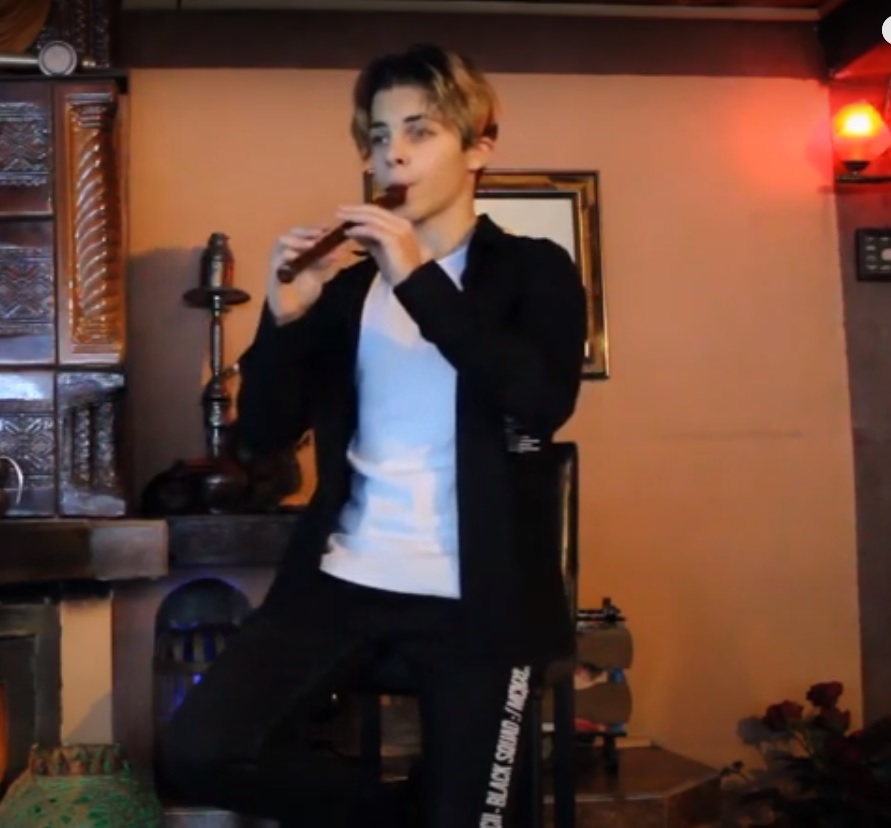
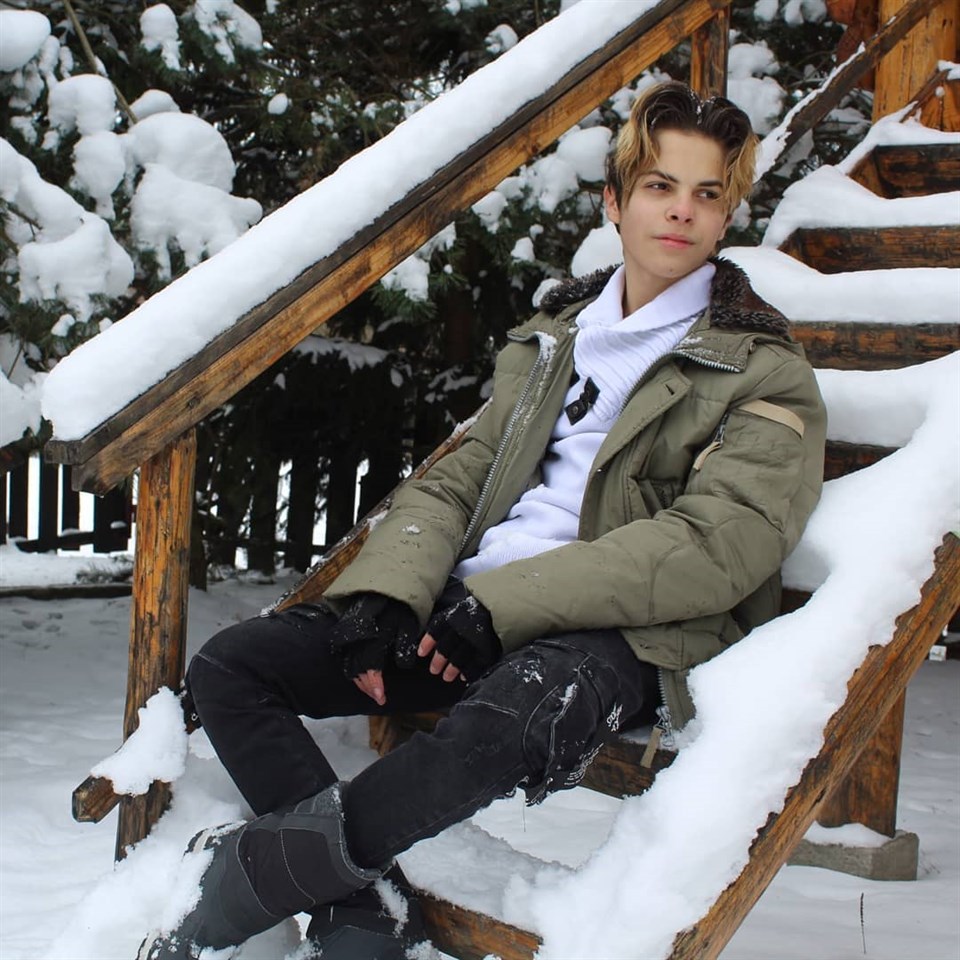
Ce jeune auteur, compositeur, interprète et producteur roumain qui arbore fièrement ses 17 ans et presque autant d’années d’un talent sans commune mesure pour son âge, me fait la gentillesse de son amitié depuis plusieurs mois. Nous partageons un point commun, la musique bien sur.
Sa spécialité, le saxophone, cet instrument chaud et envoûtant qui a fait chavirer tant de cœurs à travers le temps.
Je lui consacre une rubrique et vous aurez le plaisir de le retrouver régulièrement sur ces pages.
*****
A fost odată un tânăr român
Denis Costea
Acest tânăr autor, compozitor, interpret și producător român care își arată cu mândrie cei 17 ani și aproape tot atâtea ani de talent disproporționat pentru vârsta sa mi-a fost bun cu prietenia sa de câteva luni.
Împărtășim o pasiune comună: muzica, desigur.
Specialitatea sa, saxofonul, acest instrument cald și vrăjitor care a răsturnat atâtea inimi de-a lungul timpului.
Îi dedic o secțiune și veți avea plăcerea să o găsiți în mod regulat pe aceste pagini.
*****
He was once a young Romanian
Denis Costea
This young Romanian author, composer, performer and producer who proudly displays his 17 years and almost as many years of inordinate talent for his age, has been giving to me the kindness of his friendship for several months. We share a common passion, music of course.
His specialty, the saxophone, this warm and bewitching instrument that has capsized so many hearts over time.
I dedicate a section to him and you will have the pleasure of finding him regularly on these pages.
Bientôt la rentrée scolaire, le harcèlement omni présent
Le harcèlement, c’est quoi ?
On parle de harcèlement lorsqu’une personne est victime d’une violence verbale, physique et/ou psychologique contre laquelle elle ne peut rien faire toute seule. Ces actes agressifs se caractérisent par la répétitivité, l’intentionnalité, et l’isolement de la victime. Le harcèlement n’implique toutefois pas une seule personne. Il s’agit d’un phénomène de groupe dans lequel interviennent, outre la victime, un harceleur et des témoins. Ses formes peuvent viser l’apparence, l’identité sexuelle, le handicap, les centres d’intérêt, les origines sociales ou encore les croyances.
Quels en sont les signes ?
Ces signes peuvent vous aider, vous et vos parents, à reconnaître le harcèlement scolaire :
Vous avez peur d’aller à l’école.
Vos résultats scolaires baissent.
Vous vous sentez seul(e).
Vos camarades se moquent de vous mais vous n’osez pas en parler.
Vous pensez que c’est de votre faute.
Vous avez envie de vous faire du mal.
Si vous pensez être victime de harcèlement, parlez-en ! Cela n’aggravera pas la situation, bien au contraire : l’intervention des adultes est primordiale pour stopper le cercle vicieux induit par des comportements violents.
Le harceleur
Contrairement aux idées reçues, le harceleur n’est pas si différent de sa victime. Souvent peu sûr de lui, il utilise la violence pour affirmer sa position dans un groupe. Puni et exclu pour ses comportements inadéquats, le harceleur peut développer à long terme une défiance à l’égard des adultes. Par ailleurs, son attitude peut devenir de plus en plus violente, car c’est une manière pour lui de maintenir sa position de domination.
*****
Curând înapoi la școală, feriți-vă de hărțuire
Ce este hărțuirea ?
Vorbim despre hărțuire atunci când o persoană este victima violenței verbale, fizice și / sau psihologice împotriva căreia nu poate face nimic pe cont propriu. Aceste acte agresive se caracterizează prin repetitivitate, intenționalitate și izolare față de victimă. Hărțuirea nu implică însă o singură persoană. Acesta este un fenomen de grup în care, pe lângă victimă, intervin un stalker și martori. Formele sale pot viza aspectul, identitatea de gen, dizabilitatea, interesele, originile sociale sau credințele.
Care sunt semnele ?
Aceste semne vă pot ajuta pe dvs. și pe părinții dvs. să recunoașteți agresiunea :
Ți-e frică să mergi la școală.
Rezultatele dvs. școlare scad.
Te simți singur.
Colegii tăi râd de tine, dar nu îndrăznești să vorbești despre asta.
Crezi că e vina ta.
Vrei să te rănești.
Dacă credeți că sunteți hărțuiți, vorbiți! Acest lucru nu va înrăutăți situația, ci dimpotrivă: intervenția adulților este esențială pentru a opri cercul vicios indus de un comportament violent.
Stalkerul
Contrar credinței populare, stalkerul nu este atât de diferit de victima sa. Adesea nesigur, el folosește violența pentru a-și afirma poziția într-un grup. Pedepsit și exclus pentru comportamentul lor inadecvat, agresorul poate dezvolta neîncredere pe termen lung față de adulți. În plus, atitudinea sa poate deveni din ce în ce mai violentă, deoarece este o modalitate pentru el de a-și menține poziția de dominație.
*****
Soon the start of the school year, the omnipresent bullying
What is harassment ?
We talk about harassment when a person is the victim of verbal, physical and / or psychological violence against which they cannot do anything on their own. These aggressive acts are characterized by repetitiveness, intentionality, and isolation from the victim. Harassment does not involve just one person, however. This is a group phenomenon in which, in addition to the victim, a stalker and witnesses intervene. Its forms can target appearance, gender identity, disability, interests, social origins or beliefs.
What are the signs ?
These signs can help you and your parents recognize bullying :
You are afraid of going to school.
Your school results go down.
You feel lonely.
Your classmates laugh at you, but you don’t dare talk about it.
You think it’s your fault.
You want to hurt yourself.
If you think you are being harassed, speak up! This will not worsen the situation, quite the contrary: the intervention of adults is essential to stop the vicious circle induced by violent behavior.
The stalker :
Contrary to popular belief, the stalker is not that different from his victim. Often insecure, he uses violence to assert his position in a group. Punished and excluded for their inappropriate behavior, the bully can develop long-term mistrust of adults. In addition, his attitude can become more and more violent, because it is a way for him to maintain his position of domination.
Culture urbaine : BreakDance Genève, Le Get-Down Camps en vidéo
“Plus vite que le vent et presque aussi rapides que la lumière”
Ils sont jeunes, ils sont beaux. Rencontrons l’équipe de l’école « BreakDance » à Genève avec son énergie. Je les trouverai dans un mois pour un bel article.
Parce que respirer et vivre est indispensable !
*****
Cultura urbană: BreakDance Geneva, The Get-Down Camps în video
„Mai rapid decât vântul și aproape la fel de rapid ca lumina”
Sunt tineri, sunt frumoși. Să întâlnim echipa școlii „BreakDance” din Geneva cu energia ei. Îi găsesc peste o lună pentru un articol frumos.
Pentru că respirația și trăirea sunt esențiale !
*****
Urban culture : BreakDance Geneva, The Get-Down Camps in video
“Faster than the wind and almost as fast as the light”
They are young, they are beautiful. Let’s meet the team of the « BreakDance » school in Geneva with its energy. I will find them in a month for a nice article.